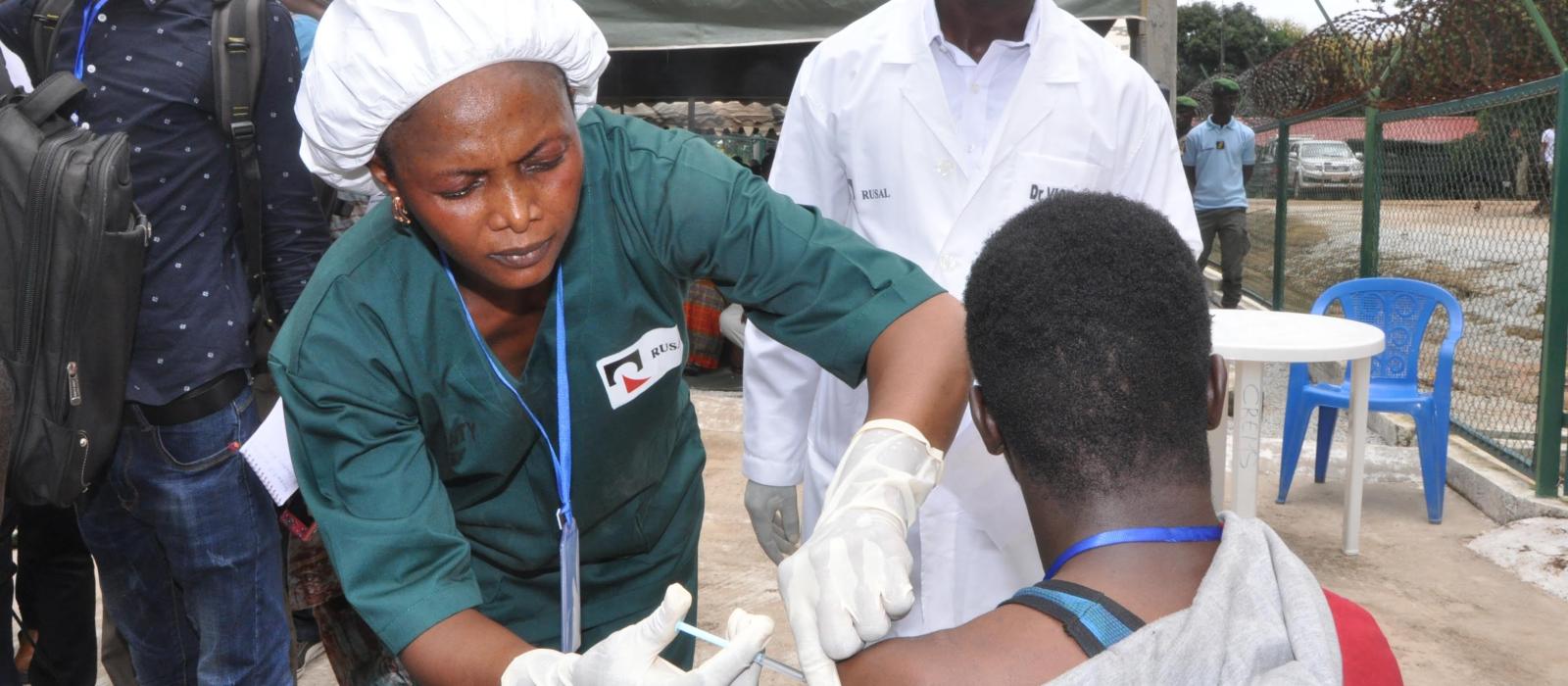
The trial programme includes year-long observations of the state of the people who have received the vaccine and the response of their immune system to it. Once this stage is completed, the vaccine will then receive international certification from the World Health Organisation and other organisations, allowing it to be used to prevent the spread of Ebola.

The vaccine was developed at the instruction of the Russian President, Vladimir Putin, after he was contacted in late 2014 by the Guinean President, Alfa Konde. In 2016, the vaccine was presented at the World Healthcare Assembly, in which the former World Health Organisation CEO Margaret Chan took part. In Russia, the new vaccine was registered in late 2015.
After UC RUSAL doubled down on efforts to curb the outbreak (in addition to developing the vaccine, the company set up a research centre, a quarantine facility, and built a hospital in Guinea through a series of private-public partnerships backed by Oleg Deripaska), the Russian foreign affairs minister Sergey Lavrov thanked UC RUSAL shareholder Oleg Deripaska for his contribution to the international effort to combat the Ebola outbreak.
Earlier, Oleg Deripaska stressed that UC RUSAL had established close relations with the Guinean Republic, and that the company had made every effort to help the population of the country that had been hit by the outbreak.
" When the epidemic broke out, we tried to make every effort to render any and all assistance that we could offer, "
– Oleg Deripaska said.
At the moment, the new vaccine is being administered to Russian doctors and other specialists traveling to regions where there is a high risk of contracting the Ebola virus, noted the Russian healthcare minister, Veronica Skvortsova.
" During the time of the Ebola outbreak, our research centre had the best outcomes in terms of the survival rate for Ebola patients: 625% of our confirmed Ebola patients survived, "
– Veronica Skvortsova said.
The vaccine was developed using a biotechnological process without the use of the Ebola pathogen. The vaccine is based on genetic material of an adenovirus and the vesicular stomatitis virus, which are safe for humans, embedded into which is a gene containing information about the structure of the GP protein in the Ebola virus.
Preclinical and clinical studies of the vaccine have demonstrated its safety and more effective stimulation of the immune system compared to foreign analogues. In addition, one of the main advantages of the Russian vaccine is its easier storage mode. The GamEvac Combi vaccine can be transported and stored at a temperature of -16C or lower, while other vaccines have to be stored and transported at temperatures of below -60C, which are extremely hard to achieve and maintain in Africa's hot and humid climate.
The new research centre, where a follow-up survey of Guineans will take place, is unique in Western Africa, both in terms of the level of new technologies that it uses, and in terms of its biological safety standards. All of the recommendations of international humanitarian organisations were taken into account when designing the Centre and it is equipped with modern medical and state of the art laboratory equipment. UC RUSAL invested over 10 million US dollars in the construction of the centre.
Currently, the centre is a leading site for the study and prevention of infectious diseases in Guinea, as well as a training centre for national epidemiologists.
UC RUSAL has been operating in the Republic of Guinea since 2001, and is today one of the largest international investors in the country. In Guinea, UC RUSAL owns Compagnie des Bauxites de Kindia (CBK), as well as the Friguia bauxite and alumina production facility. In addition, UC RUSAL is continuing with the implementation of a project aimed at developing the world's largest bauxite deposit, Dian-Dian in Boke.